Want to do a Cooking Internship?

Tuesday, October 26, 2010


A few people have been emailing me about my experience doing my pastry internship (also known as an externship, stage, stagiere, or apprenticeship). How did I decide to do it? How did I ask? How did I find what places were accepting internship applicants? These are all good questions and I am going to do my best to address them through my own experiences and opinions on the subject. I hope that, regardless if you are a cooking student or not, this will help you in your quest of finding an internship that best suits you.

How did you decide to do an internship?

For a long time the only thing I knew how to bake were chocolate chip cookies. It was only after I graduated college that I suddenly, and quite unintentionally, had any interest in baking anything else. Once I started, I began to read up more on the subject and poring through cookbooks. I started at simply making cupcakes, but I soon moved up to ice creams, custards, layer cakes. After a year or two I was throwing together puff pastry, breads, and laminate doughs. At my day job I spent my down time reading baking blogs, cookbooks, and jotting down ratios and recipes on scraps of papers and in numerous little notebooks. I was like a student cramming for exams, attempting to memorize every fact and understand each equation.

I would take the occasional cooking class to boost my knowledge, and various writing assignments allowed me to work alongside talented pastry cooks who would teach me what I wanted to know. From here I was able to understand and practice advanced skills in a more conducive environment. I knew that I didn’t want to go to pastry school as I was (and still am) currently enrolled for my Master’s degree. The thought of being the opening victim in a Saw film seemed more appealing than spending more time in class and, god almighty, accumulating more student loan debt. Furthermore, conversations with many chefs and caterers had convinced me that the best way to learn was to be in a kitchen working.
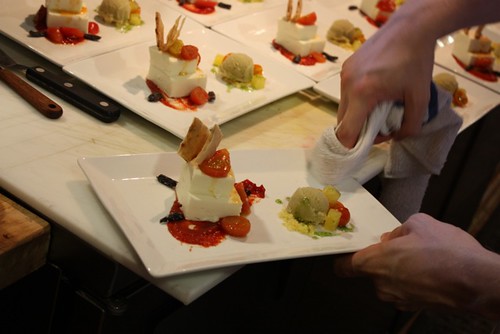

I became determined to find a kitchen that would take me in for a while and let me work and learn under a master who knew the craft. I felt that, for me, this was the most logical way to get a lot of hands-on experience in a number of aspects of the field. At the same time I would get the chance to better understand a subject and career field that, as a food writer and outsider, I had often written about but never fully understood. I felt that this experience would not only make me a better baker, but a better writer as well. Lastly, I still wanted to be a college writing professor in the future. In my opinion, the best teachers were the ones who had left academia to have adventures. These teachers usually had a broader, more comprehensive worldview that seemed to grant them more sagely understanding of their subject and students.

For me, it seemed that an internship was necessary in all aspects of my life.

What did you have to consider beforehand?

The decision to do an internship wasn’t an idea I just decided on a whim, like shooting an arrow blindfolded and assuming it would find its target. I held onto the idea tightly, sitting down and figuring out a lot of problems and questions that I knew were bound to come up. How would I get the time off from work? How much time would I need? How much time could I get? What kind of supplies would I need? What goals and skills did I desperately want to master in my time there? Who did I want to work with? What is my financial situation and how will it be affected?

This was the hardest part of figuring out my internship.

To begin, I had to find someone who would take me on (a topic I will discuss in detail shortly). Next, I sycophantically approached the Human Resources coordinator at my work and questioned what the policy on taking extended leaves and vacation might be. While I had a considerable amount of vacation time built up at my job – about three months worth – I didn’t want to cash it all in as 1) there might be the chance that my employers wouldn’t be too keen on my taking such a leave, 2) the amount or work I would return to after that long would likely drive me insane, and 3) I wanted to have some vacation time for other plans such as visiting family.

Luckily, working for a non-profit, my employer was more than happy to give me permission to encourage personal growth and recharge my batteries. We worked out that I would be permitted to take five weeks off; three of them as vacation and two of them as leave. The two weeks of leave would be unpaid.


Money is a serious aspect of the internship you need to take into consideration. As an intern you will not be paid. If you’re already a student then this might not be a change from your current situation. If you’re working a normal 40-hour work week then understand that either you’ll be cashing out your vacation or possibly going without a paycheck for a while. If this is the case then you need to be sure to budget ahead.

All of this took place in May, and the internship was planned for September. This gave me enough time to get all financial matters in order. I ensured that I had saved enough money to not have to worry during those two weeks. Afterwards, I called the restaurant I planned to work at and set the date I would work. I then conferred that to the Human Resources coordinator at my job and confirmed everything.

Money-wise, you also have to take into consideration other costs. Think about extraneous, though necessary, purchases. As an intern you may be provided with some chef’s whites, though at some places you may not. If you aren’t in cooking school and don’t already have equipment then you will need to purchase it. This can include non-slip shoes, pants, knives, a knife roll, and many other pieces of equipment. If you’re planning to bake then the number of tools you will be expected to have can be staggering. In fact, you will probably need to buy a tool box to carry them all. Though you may have some of these tools already you should expect to spend anywhere from $100-$350 on equipment for your internship. I made sure in the months beforehand to search and purchase quality tools that would serve me well not only during the internship, but afterwards as well. (I bought a lot of it through the Amazon stores of fellow bloggers so as to throw some cash their way.) Try not to be cheap on these external costs as your tools are your trade. Shitty tools result in shitty results.


Aside from money, I had to consider the actual workload. For me this would be a shift from a sedentary job in an office to standing for six to ten hours at a time working with my hands, at times doing repetitive tasks for hours on end. Are you not okay cutting and de-seeding grapes for three hours? Chopping up an entire flat of figs? Peeling, buffing, coring, poaching, and slicing a sheer rock slide of Seckel pears? You better be. Expect your feet to get sore and your body to hurt. Expect burns and cuts far worse than what you have experienced at home. It will take a while for your body to adjust to the physical demands of the job. I knew to expect this but once you are actually there the fatigue that sets in is much worse than you expect it to be. You need to be prepared to tough it out.

If you have any particular physical ailments then you need to take a step back and critically analyze how it will affect your performance. If you suffer from chronic fatigue, back pain, or don’t have the ability to stand for more than an hour at a time, then you shouldn’t be looking for an internship. You will simply act as a determent in the kitchen, slow down service, and impede your co-workers from getting their own work done. This may sound harsh, but it is the truth.

Lastly, as I previously noted, I only worked five weeks. That was the longest amount of time I could get from work, which for me was the deciding factor. Some restaurants only offer one or two week internships, and others will let you work for three or more months. I wish I could have done three months but it wasn't a feasible option when I considered my position. To make up for it I made sure to work a ridiculous number of hours each week. Though this was exhausting, I revelled in it. The notebook I brought with me everyday to record events of the day, techniques, numbers, names, recipes, and other important info proves it as I nearly filled the entire thing in the space of a month. Remember that the more time you can spend in the kitchen the better.
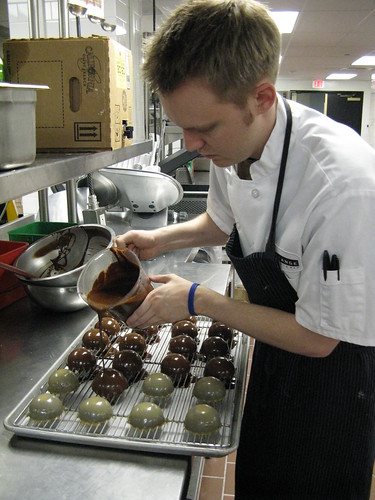

How did you find a chef to work under?

I was really lucky finding Elaine, my mentor and the pastry chef at Grange. She happily took me on and was more than willing to teach me. She demonstrated the commitment and drive needed to live in the business, often working sixteen hour days and constantly striving to create diverse and engaging recipes that would entice clients. She functioned with an ethos that I wanted to emulate: she created high-end desserts using solid techniques (both classic and modern) and utilizing seasonal ingredients. I knew this because I spent months looking at her menus and going to the restaurant and trying her desserts, seeing what I liked and didn’t like and if this was what I wanted to learn.

If you are serious about doing an internship you first need to know what it is you want to learn. I jotted down on a list various ideas, goals, techniques and concepts I wanted to be sure I could observe in a kitchen. Next, I began to profile the best possible restaurants that had pastry chefs that embodied my list and started researching both the pastry chefs and the restaurants. For me, I was able to do this second-hand via a magazine article I was working on. In it I profiled all the chefs I was interested in while at the same time observing and listening to their theories on what constitutes good pastry. After collecting a lot of information, visiting the restaurants, trying the food, and some heavy deliberation there was only one obvious choice.

Lucky for me, Elaine said yes; partially because we had developed a relationship while I was writing the article and had become friends since then. If you already have a good relationship with a chef then that might be the best advantage you have to landing a truly great interning experience.

Elaine vetted me when I also asked the head chef, the restaurant manager, and the restaurant owner for permission as well and who all had to give their approval. I had to explain to each why I wanted to intern and what my goals were. After a few e-mails they all agreed to let me on, but in return I would work with their Public Relations person as well as write some blog posts and magazine articles chronicling my experiences. I was happy to do this because I got to do more writing in other publications that I had not yet been able to access, and the restaurant was happy for the publicity.

Right from the start I was up-front about what my goals and qualifications were. I explained that, while I hadn’t gone to cooking school, I was well-experienced and had a lot of skills for a self-taught baker. I told them that I was smart and learned fast. I provided a resume along with recipes and writings that best sampled my work. I wanted to be sure they knew exactly what they were getting.

Similarly, I was sure to ask what their expectations of me were. Honesty and straightforwardness was the most important part of this exchange. Unlike other job interviews where you might be able to flub how many words a minute you can type, in a kitchen you either know how to make caramel or you don't. However, don't fret about what you don't know. The chef in charge who has taken you on realizes that the main reason you are there is to learn.

I was also a special case for Grange in that I was their first non-cooking school intern. Normally, cooking schools have a special insurance policy that covers students in case of injuries on the job. I had to ensure that I had health insurance and that, yes, I acknowledged that I could seriously injure myself while on the job. Keep in mind that some restaurants may not be to keen on accepting a non-student applicant for this reason as they could be liable.


Remember in your conversations with the chef/owner/whoever you’re talking to that they do not owe you anything. They see plenty of chefs who are more trained than you asking for internships, and who are also willing to work for free in the eventual hopes of a job. Be humble, truthful, and sincere in your approach and demonstrate why that chef or that restaurant is the only one in the world that you can see yourself learning at. That statement isn’t simply exaggeration. It should be the truth.

Lastly, do not think that any place is too far out of your reach. Just ask. The worst thing any place can do is say no. If they do then ask next week, the week after that, and so on. Don't give up! If they consistently say no and assure you that they really are not interested in an intern thank them for their time and begin your search again. (Don't burn bridges. The situation could always change in the future!)

What was your experience like?

My experience was pretty much all I wanted it to be and a lot more I didn't expect it to be. More, actually, is a great way to describe it. The people were way more fun than I anticipated. The work was more fun and much harder that I thought it would be.
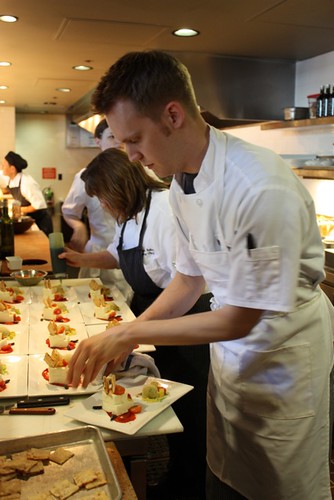

I also learned more than I expected; in the first week I experienced everything I was hoping to and many things I didn't think I would, like working the line on one of the busiest days the restaurant had ever encountered that year (I was there to plate dessert, but ended up learning how to move fluidly on the line while learning how to cook everything on the appetizer and small plate menu).

Chefs and cooks from both the banquet and kitchen side of things were happy to share with me, the pastry newbie, their knowledge about whatever they were working on. I learned all manner of skills such as how to fillet a sturgeon to how to easily plate for a 300 person event. All of this I've taken home and learned to incorporate in my everyday cooking.

I learned more about dedication, hard work, and people. Not just who they are, but what motivates them. Most importantly, I realized what motivated me.

One of the best aspects of my internship was the visceral experience of really working with my hands. I never knew that they could do some of the things I was doing. I didn't know they would learn how to really wield a knife. I didn't know they could become so immune to small burns and cuts. Coming from an office world my work usually went into the ether without me really seeing results. Here there was a physical product. Tangible proof of my labor. Even better, I could see on people's faces when they ate what I had made their joy and satisfaction.

I loved my experience. It's what happens when you surround yourself with great teachers.

What happened after?

Afterwards, I went back to my office job. It was a very hard transition, just as it had been when I first arrived at the kitchen, but I had trouble really getting back into the swing of things. I actually found myself getting somewhat depressed. It was only after sitting with some other food blogging friends that I realized that after my taste of cooking I wanted more.

When someone asked me about how my job was going, I didn't expect what I said to come out: "I don't like it anymore. I'm not happy. I want to go back to cooking. I want more time to work on my writing."

So, there it was.


The next day I started looking for baking jobs. (Grange, sadly, had no openings.) I decided I would try to bake part time and use the rest of the time to see if I could make a real go at food writing as well. I realized this meant a loss of some benefits and a pay cut, but then again I saw my options as being comfortable and unhappy, or stable and happy. I chose the latter.

Recently, I found a baking job that has a lot of opportunity for creativity, growth, and the chance to work with an amazing chef and an enthusiastic manager and owner. In addition, I've lined up a lot of writing jobs in my queue and can't wait to start on them.

My experience taught me to simply go after what makes you happy.

I encourage you to give it a shot. I went into my internship with no intention of becoming a professional baker of any kind. I simply wanted to better my pastry skills and take a vacation from my everyday life. Yet, in it I found a work I truly love doing.

Other Posts About Cooking School and Internships
Should I Go To Culinary School? - Shuna Lydon
Should You Go To Cooking School? - David Lebovitz
Want to Go to Pastry School? - Anita Chu
So You Wanna Be a Chef? - Anthony Bourdain, via Michael Ruhlman

Special thanks to Ashlee Gadd and Jackie Phongsavath who took some of these photos.

The List

Wednesday, October 13, 2010

Just a heads up everyone. Vanilla Garlic is going to go to only being updated every Tuesday. Between work, my grad thesis, and all the extra food writing and recipe developing work I have taken on I feel that the posts here have lost some of their soul and character. Rather than bamming out a bunch of decent posts a few times a week I want to provide you with great ones that will give you more to read and, hopefully, more to laugh and reflect on.

Still, every so often there might be a special non-Tuesday post should something truly awesome occur. Sign up on the blog feed, google reader, twitter, or the Vanilla Garlic Facebook fan page to keep updated (all buttons are located at the top right of the page). Thanks, everyone, for your support!


-This is a slow day.-

Within the pastry department the to-do list is our lord and master. (I and the other assistants sometimes allow the chefs to think they are, but we all know what holds the real power here.) Each day the list, often 20+ items long, dictates what has to be prepped, frozen, baked, ordered, or signed for.

On my first day, the list noted that we had to prepare cookies for the cookie plate, develop a new recipe for those Concord grapes that should be rolling in (assuming the order was made), bake up flatbread for dinner service, whip up components for the brulée; OH! and by the way, there’s a last minute, thirty-person special event going on today so we’ll need to bam out some individual cheesecakes for that as well.

Just another day.

The list is formed by any number of things: the occupancy of the adjoining Citizen Hotel, the number of reservations on the book that night, what fruits need to be used up in the fridge, what produce is in season, what desserts on the menu are selling or not selling (the mission fig-añejo is epic, so why aren’t the servers pushing it harder?), and so on.

This list is varied and fickle, often changing without warning and we're constantly adding, removing and bumping things in order to meet the sweet tooth demands of staff and customers. This may sound like a complaint, but it’s not. The list’s shape-shifting tendencies are what keep the days so interesting and varied.

We wouldn’t want pastry to become predictable now, would we?

The Pain of Cooking

Sunday, October 10, 2010

-Seriously, she just laughs this off.-

“Oh my god!” I gasp and cover my mouth with my ov-gloved hand. Jackie, the assistant pastry chef, and I both freak out at the sight. One of the other cooks, Chuy, a hulking culinary genius, is rapidly transferring boiling hot stock from one pot to another. We watch as he misses the bowl he's holding and pours an entire ladleful over his hand. The stock runs down his forearm and on to the floor. The only sound he make is a slight “Tsst” sound out of annoyance rather than pain.

“Doesn’t that hurt?! Are you OK?” I say, stunned. I would have lost my nerve due to my intense allergy to pain.

“No, it’s not that bad.” He laughs and pours another ladle of stock. More blazing hot liquid washes over his fist. Chuy doesn’t seem to notice.

Working in a kitchen requires an almost super-powered level of pain tolerance. I’ve gotten by so far with only minor nicks and burns, nothing major, which is surprising considering my knack for hurting myself on a regular basis in life. Yet, the worst I’ve suffered so far is accidentally picking up a red-hot spoon that had just come out of the oven (it was being used to pin down a piece of parchment paper). Lucky for me, I came out of it with a minor first-degree burn, nothing I couldn’t work right through.

“It’s not pain until you get home and have time to think about it,” notes Hillary, a cook in the banquet department easily identified by her punk aesthetic. Her arms are a Smithsonian of pain, covered in scars of every color, size, shape and texture. These are proud medals of life in a place where one must exist in a sharp, slippery, and molten-hot world.

Everyone told me that before the internship was over I would have my own scar. I was able to escape body intact though the kitchen was very vocal on the movement to brand me on my last day.

How I Will Leave

Saturday, October 2, 2010

-Elaine, working me to the bone.-

After an entire month, four and a half weeks, of working in the pastry department at Grange I feel like I'm in some odd in-between state. I am abandoning my chef's whites and dressing back into my civies. Wardrobe aside I'll have to completely readjust myself. I have to adapt to a more sedentary job once again as opposed to running around and working with my hands. No more swearing, god-fucking-dammit, as I work around families, children, and more vernacular conservative types. The worst injury I can suffer at the office is a paper cut, as opposed to the hot, sharp, slippery world I'm leaving behind.

Out of the frying pan and into the cubicle.

I look forward to seeing my co-workers and going back to my job. To be honest, I'm anxious about the 700+ e-mails in my inbox. And, though I set up everything to operate just fine in my absence, I secretly hope that the place burned down so that my presence is seen as necessary (in the sake of job security during this economy).

Still, I will miss Grange. I will miss my pastry peeps. I will miss the banquets for 120 people and having to make and roll espresso-chocolate roulades for them in under two hours. I will no longer scoff at the challenges on Top Chef because I understand how difficult they really are now. I understand that even the most skilled bakers burn butter and caramel from time to time. I will miss the delicious family meals and chatting with the other cooks. I will not miss the smell of the meat fridge and having to play Tetris with the buffet towers in there in order to get to the freezer. I will miss the little nuggets about savory cooking from the Kitchen and Banquet departments. I will miss the sore feet. I will miss burning my hands on pans and cutting myself with knives. I will miss Kara, Dennis, Hilary, Chef and all the other who were so very welcoming to me and were eager to teach me everything from the grace of the line to pairing cocktails. I will miss Melissa and Ashlee who cheered me on and helped this little dream of mine flourish into reality. I will miss the pastry assistants, Jackie and Ashley, and the daily banter we got to share. I will truly, sorely miss Elaine Baker, who took me in and taught me everything she could. Who put up with my sass and shot it right back. Who taught me how to keep calm and carry on, and that dessert may be last, but that it should never be least.

I got everything I wanted to out of my externship. I learned more in a month than I ever could in a year at cooking school. My skills are honed, and my confidence in the kitchen a thousand times stronger. I can plate for two or two-hundred now. I can make sugar sing.

I entered as Garrett but left as Gianduja, Randy's Twin, and F.I. (aka: Fucking Intern). I leave as a baker with experience; a more confident cook and food writer.

-A collective calm in a sea of crazy.-

Spirits and Sweets

Saturday, September 25, 2010

-A good spirit can compliment a good dessert.-

"Ooo, yeah, this might be difficult." Kara takes another bite carefully dissecting each component and processing it in her head. It seems that this dish has stumped her a bit. She quickly scoops up a bit of sauce with her spoon and pops it curved side up in her mouth in order to smear it across her tongue. She looks at us both, "We'll have to try a few different avenues."

She quickly pulls down three bottles from the glass shelves in the mirrored liquor cabinets standing tall behind her. She asks one of the bartenders to pull some scotch glasses over. Lots of them. Enough for each person: Elaine, the pastry chef; Kara, the restaurant and bar manager; a waiter, the bartender, and myself. We have a lot of drinking to do.

It's about two in the afternoon and while most might consider this a bit too early to be taking nips from the bar without paying for them we do this for work. It's a good day at work when you're sipping 10-year old brandy while nibbling a piece of warmed chocolate upside down pear cake with a scoop of vanilla ice cream and drizzled with a bit of pear sauce lightly spiced with green cardamom. I love this job.

Dessert pairing is the last crucial step in the development of a pastry menu. After the dessert in question has been developed, tested, and tasted (repeat ad nauseam until reaching a state of perfection) it's taken upstairs to meet the lead bartender and the restaurant manager. Everyone gathers around and we break down the core flavors. In this case we're focusing on chocolate, pear, and cardamom. (For the most part we ignore the vanilla ice cream as it generally pairs well with nearly everything and it isn't the focus flavor so its consideration is minimal.)

This particular dessert has been proving to be somewhat difficult. Each prime flavor generally speaks towards a wholly different kind of liquor. Chocolate prefers a dark beer or near ebony-hued port. Pears go with champagne and Eau de Vie. Cardamom's earthy coolness generally lends itself well to a spicy scotch and most amber rums. Since this particular dessert seems to go in every which way pairing-wise the group is at a slight loss.

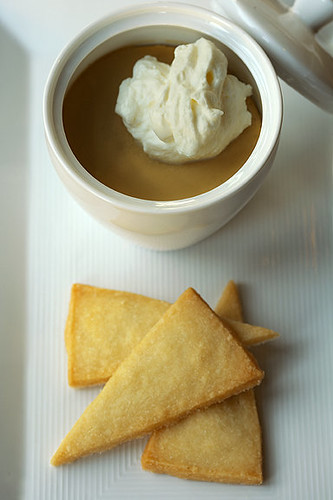
"With the butterscotch pudding we went through about fourteen different pairings before we settled on a basic champagne cocktail," Kara notes. The champagne cocktail, champagne poured over a raw sugar cube soaked in bitters, was able to cut through the brown butter flavor of the pudding and highlight the brown sugar flavors making them sharper and more intense.

Kara pulls the cork on the first bottle, an Armagnac de Montal. It's a spirit whose flavor profile lends itself well to sweeter fruits. Kara pours a little in each glass and everyone in attendance takes another bite of the cake followed by a slow and careful sip.

Silence.

"I like it." I do. I'm a sucker for a good Armagnac, but this is outstanding. The flavor is light and has a sweetness that pairs well with the natural sugar in the pears and the golden, saccharine flavor of the caramel that covers them and that has soaked into the chocolate cake. Furthermore, it cuts through the richness of the cake.

Elaine and the others all concur. This is a winner. However, we soldier on, dedicated to our mission of finding an even more perfect pairing. A tough job, and all.

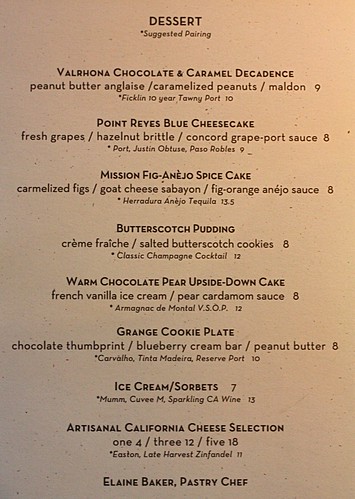
-The dessert list (as it was last week) with pairings noted.-

"Ron Matusalem. It's a spicy rum," the old-tyme paisley-inspired label looks promising as it fronts the dark liquid inside. Kara pours. Another bite and another sip. Another bite. Another sip.

The bartender, a slight girl who looks like a twenty-something Wednesday Adams speaks up first, "The cake likes the rum, but the rum doesn't like the cake."

"I agree," notes Elaine.

"What they said." I concur with not at all forced gravity.

After a drink of the rum the cake's cocoa flavors glow. However, take another sip after the cake and all the sugar makes the rum bitter and peppery, like liquid ash coating your mouth.

Like any pairing you learn not only from the good ones but from the bad. A cheesemonger friend once told me that you actually learn more from a bad pairing than a good one. The bad ones stay in your head and with that information you can generate a more concrete rule set for future pairings, whereas a good pairing generally only exalts that one particular match. Like hunting for a date online finding a good match takes time. Plus, food and drink are finicky with each other. There are many bad couplings and some just simply don't click right. It takes a few gos before you find and hit it off with the right one.

We all lift another glass, one filled with Germain-Robin, a fine alambic brandy. The flavor is strong and burns in retaliation to the softer pear flavors, and annihilates any hint of cardamom with its overly scotch-y flavor. While it might be delightful with a caramel cake or a plain chocolate cake it has no place with this dish.

"Hmm... I have an idea. I want to order in a black rum. It'll take a few days and I've been looking for an excuse to get some. I think that with this cake it'll fly off the shelves," Kara states enthusiastically. "I want more options to try with this," she nods at the dessert now destroyed by our many forks.

"Do a lot of people actually order the dessert pairings?" I ask.

"They do. More than you would think. In fact, if we have a rather unpopular liquor on the shelf and we pair it with something, we almost have to order more by the end of the week."

Like anything else, a good pairing sells itself. However, when it comes to dessert, pairings are often relegated by customers and simply being excessive and by restaurant owners as being a step too much and who are often content with simply offering a list of dessert wines and spirits (read: port and scotch).

In the end, we're in accordance. The Armagnac is the winner. Hands down. The new menu will be typed up shortly with the new dessert item and its decided pairing. In a week, once the rum arrives, we'll go through this process all over again.

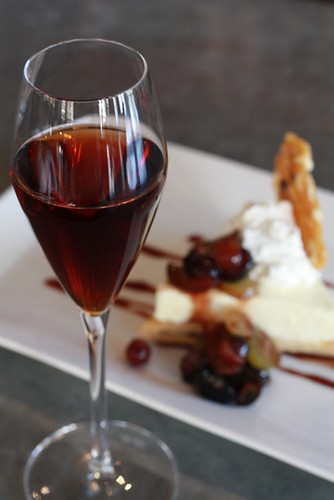
-Blue cheesecake made with Point Reyes. On the side are heirloom grapes served in a Concord grape and Port reduction. It's all topped with whipped cream and a piece of hazelnut brittle. We serve it with Port. It is transcendent,-

Dessert Development

Sunday, September 19, 2010

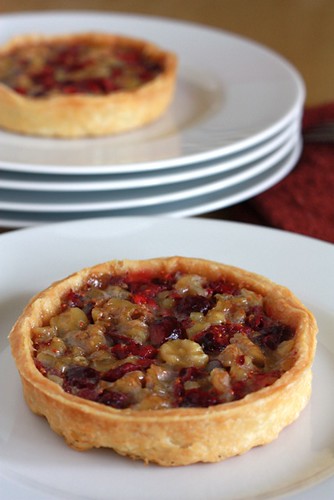
-What?! We have some frozen cranberries in the freezer? Who ordered those?! Quick, send them into a tart!-

"We just got handed a flat of figs."

My neck hurts as I lift my head up. It always gets sore after one of these chop-fests when I mise everything out for a recipe. I've just spent 10 minute de-stemming and dicing four pounds of figs for the muffins that'll be plated for breakfast and weekend brunch services. More figs means more repetition. The only possible plus side to this news is that I might be able to beat my personal fig dicing record of 5 seconds.

"What? More? Since when?" I ask before quickly snapping my neck around making it pop a few times. Elaine, my pastry chef, doesn't wince. She hates when I crack my knuckles or pop my bones and often yells at me to stop, but it's my bad habit. However, fig trauma seems to have caused her to go spontaneously deaf to it as she fails to chastise me.

"Well, we have a flat in the back that seems to have gone unnoticed and it needs to be used. It's been tossed our direction, as usual." Processing the problem Elaine begins to quietly talk to herself at a frenetic pace. A sort of prayer to the Baker Gods who usually send her an answer in the form of a cake or tart.

When she says "as usual," it's true. The pastry department is sort of the neglected youngest child of the kitchen, and as such we get the hand-me-downs from savory and banquet departments. Fruit in particular is often tossed at us with unrelenting and unsympathetic regularity. Baskets of soft berries, rock hard pears, ancient apples, and butternuts that are withered and aged like a village elder all eventually make way to us. We're the River Styx of produce, ferrying fruits and vegetables to their final destination.

Still, we make it work somehow. I've learned that nearly all fruit, no matter how bad it may seem, is redeemable. We toss the truly funky stuff: anything fuzzy, moldy, or with odd cultures that seem to show signs of intelligent life go to the garbage. Everything else is simply very, extremely ripe and ready to be used immediately. The whole process is reminiscent of cleaning out your attic: we trash the junk and see what can be re-purposed into something useful.

"We'll do a fig crostata. Easy, fast, and it'll be well received. We'll brush on a layer of fig jam first, place on quartered figs, wrap it up and cover the whole thing with a egg wash before sprinkling a bit of pearl sugar." The decision is made. Screw you, figs and time. You've been bested again.

-These tarts, created for a special event tasting, are an example of some of the more rigorously tested recipes we do.-

Recipe development is always in motion.

Of course, it isn't always this way. Not every dessert we run is decided based on slighted produce. We work seasonally and change out something on the dessert menu at least once a week to keep it shifting and new. Chocolate decadence came off today and chocolate upside-down pear cake is now on. Tonight we're also putting on a chocolate cherry bread pudding dessert special, a carryover from a banquet that ran yesterday. The bread pudding is luxurious, addicting, and we have a ton of it. Warmed in the oven and served with a cherry cause and freshly whipped cream any customer would slap their own mother for a piece after just one bite.

Our desserts are usually a lot more thoroughly planned. We test and re-test, taste and re-taste, and pair with liquors and spirits. We plan our little hearts out to make a varied, engaging dessert menu that diners will fall in love with. Our fondest hope is that you'll be wracked with frustration and indecision over our dessert menu because every item looks so good.

Elaine whips out the sugar while I continue chopping so I can get to sorting out the next box of figs. I ignore the crick in my neck and focus on the fluid motions of my pairing knife. As it laces its way through the fruit I realize that it, and I, are getting more used to the ebb and flow of this kitchen.

This'll be easy. You should have seen us last week with the bushel of blueberries.

White Chocolate Caramel Sauce

Sunday, September 12, 2010

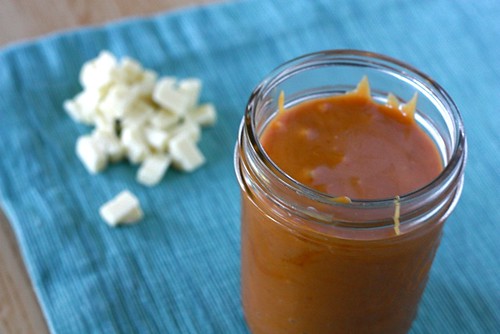
-Pictured: Crazy Tastiness.-

I have a weird thing about baking that I've learned is actually pretty common. After you spend an hour or so getting your ingredients together and you've move on to the mixing, baking, dredging, ganaching, torching, freezing and so on you get a little tired of your project. By the time you finally have the final product, you're kinda done with it. For the moment, at least.

I know when I bake a huge batch of cookies I usually eat half of one and then box the rest up for later. Make no mistake, I will go back and demolish those cookies so fast you'd think the last one would grant a wish. Seriously, baked goods are not safe in my house. However, at the moment of completion all I want is a taste to ensure that everything went well.

This experience is compounded ten-fold over at my externship. In one day I'll whip up a batch of flatbread, 200 peanut butter cookies for the cookie plate, a few dozen butterscotch puddings, dice up a billion or so figs, and whip up four flats of individual cheesecakes. That's nothing to say of what the other two people I'm working with are cranking out as well. We keep busy with our baking projects and, as responsible bakers, we taste as we go. We taste a lot. So much so that you get just sick of it all.

Honestly, my consumption of sweets has plummeted since I started this internship.

One of the few exceptions to this rule is our recipe for white chocolate caramel sauce. There's not much to describe as it's exactly what it sounds like: caramel poured over and mixed with white chocolate. It is outstanding. Make it thin for a super syrupy sauce or cook the sugar down to achieve a more spreading consistency. If this sauce were a slutty friend I would totally sneak out of work and have sex with it in my car. Seriously. It is awesome.


White Chocolate Caramel Sauce
Makes 1 pint

100 grams sugar
200 grams cream
2.5 grams kosher salt
250 grams white chocolate (buy the good stuff)
25 grams unsalted butter, diced and room temperature

1. Place the chocolate and butter in a bowl and place a strainer over it. Set it aside. Warm the cream and salt in a pot over medium heat making sure not to scald it. In another pot set over medium-high heat place the sugar and begin to whisk it. Eventually the sugar will begin to crystalize, then melt before turning an amber color (this is called a dry caramel).

2. Add some of the cream to the sugar. It will froth and bubble violently. Continue to stir constantly while adding the cream. Once it subsides a bit add the rest of the cream. Let it cook for about 30 seconds more.

3. Once the froth has simmered down a bit pour through the strainer (to catch any sugar crystals) over the white chocolate and butter. Whisk together until smooth. Pour into a jar and cover. Serve over cookies, ice cream, or what have you. It should keep for a few weeks. Should you get a super thick sauce, just pop it in the microwave for a bit to soften it up before serving.

This is My God Now

Friday, September 10, 2010

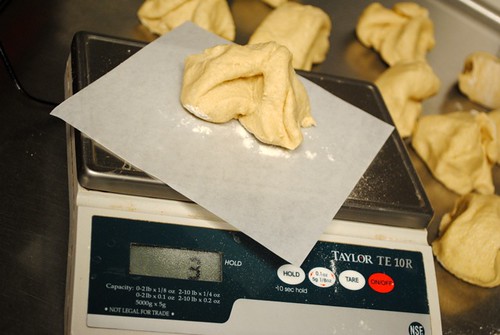
-"Each piece of flatbread dough will be exactly three ounces. So sayeth your God."-

You may think I'm joking. But if you've worked in a professional baking kitchen then you know the truth. This is your source of focus and the Truthsayer of the kitchen. Only the scale can be trusted.

Just a heads-up on the internship: I'm doing a bit more blogging on the subject in a few other places. Check out my ongoing mini-series over at the local Sacramento blog, Eat & Drink. I was also recently profiled in the Sacramento Bee. Furthermore, you can find one of the most popular recipes from the pastry department I work in over at Simply Recipes. It's for butterscotch cookies. They are crazy good. As in, screw your significant other/best friend/child/parents I want the whole batch for myself good.

Picture by Ashlee Gadd.

I Swear

Sunday, September 5, 2010

"Listen, you neglected prom night dumpster-baby..."

"Gosh, Garrett, don't mention your mom's sex life like that," replied Jackie in a dramatized huff.

"Oh please, she's a saint compared to your street walking mom. How is work in the skankiest alleys of Sacramento?" I shot back.

"Let's not confuse my mom with what you do on your own time off of work."

"Kids, don't make me come back there!" Elaine called out. She shook her head and didn't bother to look up from epic pile of figs she was slicing.

It took about, oh, a day before I was able to get myself comfortable in the kitchen and start bantering with the rest of the kitchen staff. The delay attributed to my having just started and I had to feel everyone out. Mainly, though, because my job working with children and families all day had finally trained me to zip up my sailor's mouth. Years of teaching my tongue to have a filter and all it took was twenty-four hours of flour, sugar, and backsass.

Elaine and Jackie, the pastry assistant, were more than encouraging in my blooming swearing streak. "In fact, you probably should be swearing more, otherwise you won't keep up with the rest of the kitchen," noted Elaine.

I had anticipated that I would have to enter the kitchen strong and stake out my place against the hazing. Enough reading of kitchen memoirs and hearing from occupational kitchen friends of mine who regaled me with epic stories of lewd conversations, immature practical jokes, and rampant harassment had given me enough time to mentally prepare myself. Still, I was surprised that pastry has the same sort of dialogue. To be honest, I imagined that the world of crostatas and cheesecake would be, well, sweeter. Something more filled with dainty rhetoric and innocent laughter. Not a world where the girl to my left is insinuating that I probably kept dead bodies in the trunk of my car with plans to sexually violate them.

However, the rest of the kitchen staff hasn't disappointed and my expectation have been fulfilled. Indeed, on day one another staff from the savory kitchen side, Dennis, slipped in behind me to whisper in my ear, "I fucking hate interns."

I smiled and didn't even both to look away from the pile of flatbread I was rolling. I let out a laugh that sounded more confident then I probably was, "Oh? And why is that?"

"They're fuckin' idiots man. What school did you come from anyways?"

"Social work," I stated as plainly as possible.

"What?" he was obviously not expecting this answer. Most interns probably said Le Cordon Bleu, or the local community college cooking program.

"I didn't come from a school. I work in social work, work as a food writer, and am currently finishing up my Master's," I huffed out. Probably a bit much, but the point was made: I was not your average intern and I want you to know it.

"Oh, man, you're the worst kind," he grumbled, but I could hear him suppress a smile without seeing it.

"That's what your mom said she thought about you at first. Sad thing she was right, isn't it?"

He pushed me on the shoulder, mumbling about the fucking interns while the rest of the pastry crew, and a few kitchen crew who overheard laughed. I mentioned something about finding out where he lived and murdering him in his sleep before getting back to work. Same old, same old.

It's a lot of fun actually, being able to verbally let lose like this. It's far more therapeutic than yoga, glasses of wine, or afternoon naps have ever been. The only thing I'm worried about now is eventually going back to the work place and bottling up again.

...Ah, fuck it. I'll worry about that bridge when I cross it.

Vanilla Garlic All rights reserved © Blog Milk Powered by Blogger