A little warning: This is a graphic post. I'm not quite sure how I came about researching this topic. I just kind stumbled onto it by accident like the
Tasseography or
Makrud lime post. Somehow when reading about colonialism and Edward Said's theories I wandered into thinking about cannibalism, which prompted a Google search, which piqued my curiosity about what people taste like (pork seems to be the popular answer among serial killers and computers), which led to finding far too many YouTube videos and thus led me to do a long research for the next few days in my spare time when not researching for my school project.
I decided that, heck, this is a food blog. Might as well look at all aspects of food, right? Good enough of a forum as any to talk about these things.
I've taken a few steps too far ahead of you though, so allow me to start again. Placentophagy is the act of mammals eating the placenta after giving birth.
I think most people reading this blog are intelligent people, but still a quick refresher for sake of the argument is in order. The placenta is an ephemeral, highly vascularized organ that attaches developing fetal tissue to the uterine wall. It transfers nutrients to the developing fetus and infant and removes waste to the maternal kidneys. Furthermore it protects itself from the mother's own immune system by producing certain chemicals and hormones that trick the mother's body into a copasetic state. When the mother gives birth the placenta is delivered as well.
In the animal kingdom placentophagy somewhat practical and common, even among herbivores. The animals usually need to eat it for nutrition in order to produce milk for their young. Furthermore, the placenta contains naturally occurring sedatives that reduce the pain that occurs after childbirth. Since a rat or moose can't get a prescription for some codeine, it makes sense they would resort to eating the placenta.
A small number of humans do practice placentophagy. The idea is that it helps prevent postpartum depression. However, its use in Chinese medicines has long been practiced and is still used today.
Technically, this act does file under anthropophagy or cannibalism. It is the consumption of human flesh. Now for the most part cannibalism is practiced in small, scattered groups around the world and the occasional serial killer. These groups of people (minus the killer who is just crazy) practice it in war and in funeral rites as a form of respect.
Yet here seems to be a wave of people trying it out now. The thing is, they aren't doing it from a medical or curative standpoint. Rather, the mother is perfectly jubilant and fine. No, she, and possibly her husband/partner/friends/family wish to partake in her homegrown meal for a specifically radical gourmet purpose. I mean, truffles are hard to come by, but a placenta? Well, there's quite a bit of work involved to get one of those to eat.
Apparently a small movement of people in developed cities and suburbs in Europe and America giving it a try. Don't believe me? YouTube has
plenty of videos and you can find a
few blog posts of it.
So how do you prepare it? Well, to get one you have to know someone who is pregnant. The hospital is upposed to give you the option of taking the placenta home. I mean, it is YOURS after all. Some cultures bury them, other people (read: hippes) make prints with the placenta and frame them, which actually seems more creepy to me. However, a variety of recipes appear online, from
lasagna to cocktails.
Slow food? Organic? Technically this is Slow Food extreme. Nine months to be exact. It's definitely local. You know what went into growing it. If the grower/farmer/source/mom ate a healthy diet of veggies and produce, then it should be healthy to eat. If she only ate McDonalds will it be greasy? If she had a steady diet of pistachios, apples and cream will the placenta have those subtle flavors in the background like a piece of pork can when fed a delicious diet during its life? How many placentas have a slight undertaste of whatever craving the mother has had ("Do I taste pickles and strawberry ice cream in this?"). No animals were harmed or killed so, technically, vegans and vegetarians can eat it.
Personally, I think it's odd... Thing is, very few cultures practice placentophagy. Those that do have utilized it as a part of their traditions for centuries; it's an ingrained part of their way of life. If you aren't a part of that culture, raised in their ideology wherein the practice is a vital signifier for your spiritual, societal, and familial self then you are simply emulating a practice which, across cultures, is unneccessary. If you decide to cook and eat a placenta for the purpose of blatant voyeurism or thrill-seeking the way one drinks snake blood in Thailand then I think you're skirting the realm of taboo.
I'll be honest. The idea grosses me out. Still, who am I to say? If mom and pop really wanna try it, then go crazy. Disease wise there is zero risk in the mother eating it. If the mother has HIV or another blood disease however, she shouldn't serve it to guests.
Some may argue that my opinion doesn't stand to reason. Going out and trying new things! Anthony Bourdain does it! I saw him eat a yak testicle on TV! Well that was a yak testicle. Not a human organ that was attached to your wife/partner and child (I use these terms because you can't buy them at Whole Foods or Kaiser Medical so I assume you have to know who grew it pretty intimately). In essence you are eating a piece of the mother and child. I'm sure there is some new age stuff out there that makes this all holy and whatnot, but I dunno.
Isn't it like mother's milk? Yes, I suppose. In a way. But you have to drink that as all mammals do. And then we stop. Not all animals eat the placenta, and if they do it's because the mother needs the strength and proteins to make milk. People can make a salad with some eggs and pasta.
In my mind, part of me can see reasons why it could make sense to eat it if you wanted. However, I can find no reason why you must, have to, or should. I can think of more reasons you shouldn't. Mainly that yes, you are breaking with societal norms and while I'm all about fighting the machine, sometimes I'm just fine letting it run its rules.
My conclusion is this then: there is no reason, aside from breaking popular social taboo,
not to eat it. However, there is no medical proof due to a lack of study on the subject that it can do anything amazing for you either. Given, technically, it is an extremely nutritious piece of tissue and muscle, though it is chalked full of hormones (I guess we'll always complain about hormones in our food). Plus, you can get this nutrition anywhere else just as easy, if not easier. Therefore there is no reason
to eat it.
So it comes down to personal opinion.
Ah, but would I? I suppose you are wondering my own position. My answer? Depends. If I were to turn this post into a real research article for publication for my MA or future PhD, then yes. If for just kicks and thrill-seeking? No.
Still, for those of you asking yourselves this question, why is your answer your answer? If you reply, "Because eating a human organ is wrong" then tell me why it is. Then ask yourself what formed the rules and ideas that formed my opinion that this is wrong? You could go down this trail of questioning for hours, but I just want to encourage you all to put some real thought into it. Of course, a simple "It looks way too gross," is perfectly acceptable too. We'll call it a quick practice in sociology and ideas.
Comments on this post are encouraged, so please state or work out your thoughts, or debate there. =)





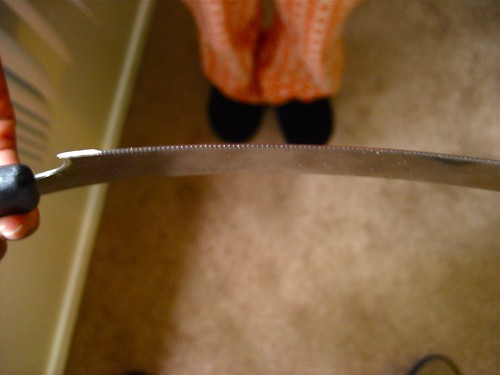 I call it this because whenever I try to use it only takes about thirty seconds for me to get so pissed off that I throw the damn thing into the sink and hunt down anything else with a sharp edge to it.
 Caveat emptor, people.
